Claims made from the dais — and what residents can actually do about them
When an elected official makes a public claim about a matter under their authority, the claim becomes part of the record. This page captures specific statements made about the proposed Lavon hyperscale data center, places those statements against the documented public record, and lists the legal paths Texas residents have when they believe a councilmember is misinforming the community.
§1 · The post — resident opposition framed as China-linked
On approximately May 25, 2026, Council Member Travis Jacob — identified by Facebook’s “Author” tag — posted the following to the Lavon, Texas community Facebook group, sharing a Fox News article. The post is reproduced verbatim:
“Anti data center information and protests are being linked to China, as they rush to claim AI dominance. Do not be fooled by misinformation and propaganda.”
Travis Jacob (Author tag), Lavon, Texas Facebook group, posted 14 hours before capture; captured 2026-05-26. Original post URL: facebook.com/share/p/18pPrfSXFU.
The shared Fox News article reads, in pertinent part:
“Anti-Israel agitators. Climate activists. Communist groups. Experts warn a growing activist network united by anti-American sentiment — and in some cases China-linked funding networks — is now targeting America’s AI infrastructure and industrial power. Fox News Digital found many of the same movements protesting side-by-side across the country, including groups opposing new AI data centers over energy and environmental concerns. ‘What all of these protests have in common … is that anti-American trend within them,’ Hudson Institute fellow Zineb Riboua told Fox News Digital.”
Fox News Digital article shared in the post above, attributing the quote to Hudson Institute fellow Zineb Riboua. Captured 2026-05-26 from the same Facebook post.

Council Member Jacob’s caption frames the residents organized against the proposed Elevon hyperscale data center as participants in — or victims of — foreign-linked “misinformation and propaganda.” The Fox News article he shared does not name Lavon, the Elevon parcels, the residents’ group, or any specific opponent of the Lavon project. The community response in §1b below speaks to this directly.
§1a · Council Member Jacob’s comment-thread statements
The following statements were posted publicly by Council Member Travis Jacob, identified in each comment by Facebook’s “Author” tag, in the comment thread under a post in the Lavon, Texas community space. They are reproduced verbatim with their posting timestamps:
| BPP property-tax framing 1h before capture |
|
|---|---|
| “130 or more” data-center count framing 1h before capture |
|
| “Anti-American” framing of property regulation 1h before capture |
|
| Small-land-area framing 36m before capture |
|
| “Close to the places you mentioned” framing 32m before capture |
|
A constituent in the same thread frames the resident position directly:
“It’s not that we are against data centers, we just don’t want a hyperscale data center in the middle of the neighborhood.”
Constituent reply in the Lavon Texas community thread, captured 2026-05-26
Image captures of each of the five comments above are cached at lavon_dossier_cache/2026-05-26_jacob_fb_comment_*.jpg. The full thread context including parent post and constituent replies is preserved in the composite screenshot at lavon_dossier_cache/2026-05-26_jacob_fb_thread_and_lavon_reality_graphic.png.
§1b · The community response — rebuttal graphic and Community Note
The Lavon residents’ community has produced two on-the-record responses to the Council Member’s statements.
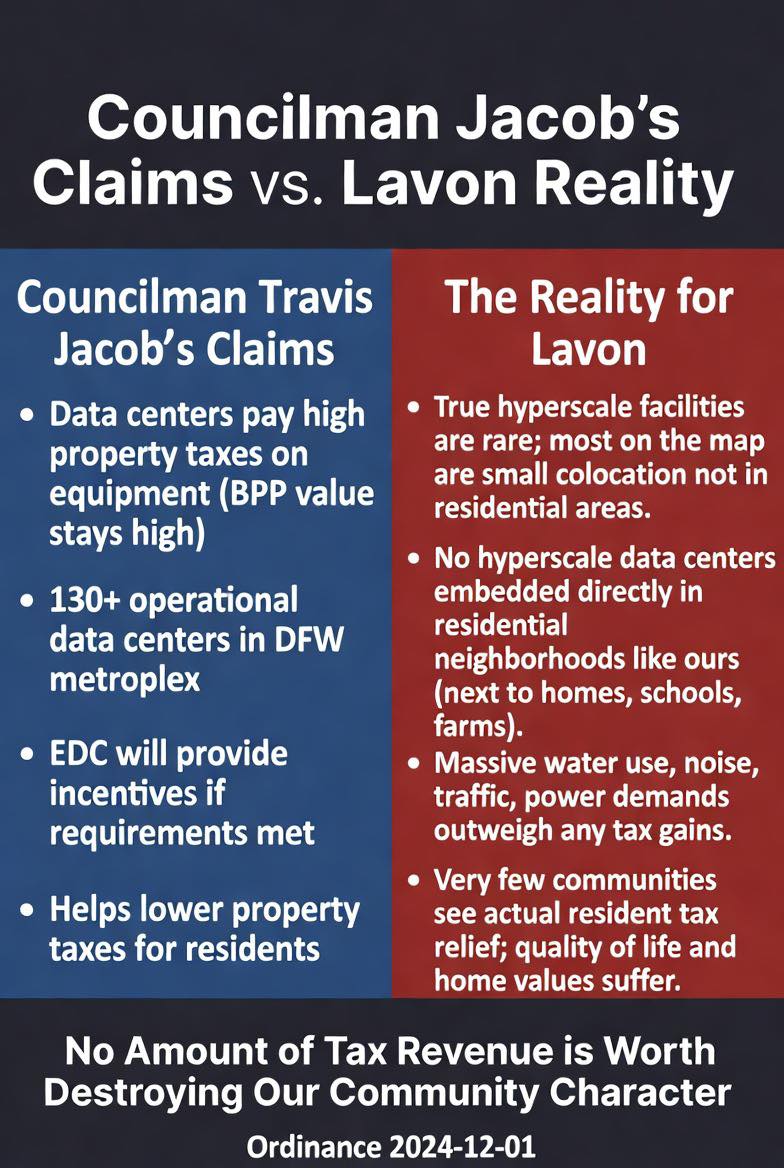
First — a side-by-side claims/reality graphic addressing the four substantive framings from the comment thread (§1a above):
Second — a community-written commentary on the Council Member’s post and the Fox News article it shared, with the Facebook-attached Community Note:
“Councilman Travis Jacob Thinks Lavon’s Data Center Opposition Is a Chinese Plot.
Our elected official, fully aware of the legitimate concerns raised by residents — massive power demands straining our grid, enormous water consumption, noise pollution, and the overall transformation of our community — has instead chosen to share a Fox News article framing these protests as part of a China-linked, anti-American activist network.
Rather than engaging with the substantive questions and fears of the people he represents, Councilman Jacob dismisses them as ‘fake protests’ and foreign influence.
This isn’t leadership. It’s a profound failure to address reality in favor of conspiracy rhetoric. Take it for exactly what it is — a clear indication of where our councilman stands when it comes to prioritizing Lavon residents over industry narratives.”
Community commentary on the Council Member’s post, captured 2026-05-26
Editorial note: the phrases “fake protests” and “foreign influence” above are the community commentary’s characterization of the post’s effect. Council Member Jacob’s own documented words — reproduced verbatim in §1 and §1a — are “being linked to China” and “misinformation and propaganda”; he is not on record using the phrase “fake protests.” Readers can compare the characterization against the source above.
Community Note (written by a Facebook user): “The cited evidence does not show that local data-center opposition is broadly China-funded or anti-American. The report itself says Americans have legitimate concerns about water use, energy costs, and grid capacity, and calls for funding transparency — not treating all protesters as foreign-linked agitators.”
Community Note attached to the Council Member’s post on Facebook, captured 2026-05-26
Two background facts make all of the above statements worth pinning to the record:
- Council Member Travis Jacob was on the Lavon City Council on December 3, 2024 and seconded the motion that adopted Ordinance No. 2024-12-01 — the amendment that defined and permitted hyperscale data-center use on Land Use Parcels 8 and 9. The vote was unanimous. (See the vote attribution →)
- As of May 26, 2026, no buyer is under contract for the parcels; the Lavon Economic Development Corporation and the City are actively marketing the site for a hyperscale data center. (See the buyer-pipeline record →)
§2 · What the documented public record shows
§2a · On the comment-thread statements (§1a)
Each of the five comment-thread framings merits a sourced response:
| Statement | What the public record shows |
|---|---|
| BPP property-tax framing. Equipment-refresh cycle keeps Business Personal Property value high, therefore residents get sustained tax relief. | The Texas Comptroller’s data-center-exemption program (Tex. Tax Code §151.359) provides large state sales-and-use-tax exemptions for “qualifying data centers” on the very equipment whose BPP value the statement cites. Local jurisdictions also commonly grant Chapter 312 or Chapter 380 property-tax abatements as part of EDC incentive packages. Whether Lavon residents actually see net tax relief from a hyperscale build-out depends on the negotiated incentive package, the BPP abatement schedule, and the cost-shift onto residential ratepayers for water, electric, and road infrastructure — none of which has been made public for the Elevon parcels. The closed-session items “Chalkboard 27, Ignite, and Pathways in proximity to SH 78” (Record §6) and “Resolution No. 2026-05-01” (the Professional Services Reimbursement Agreement amendment for City expenses tied to the Elevon DA scope/expansion) suggest the incentive structure is still being negotiated. |
| “130 or more operational data centers across the metroplex.” Framing implies Lavon is one of many similar projects. | The datacentermap.com URL Council Member Jacob himself linked aggregates colocation, edge, and small enterprise facilities — not hyperscale builds. The vast majority of those 130+ DFW listings are conventional commercial/industrial sites, not hyperscale campuses placed next to single-family residential. The category-mixing matters: the Lavon ordinance (Ord. 2024-12-01) explicitly defines a “data processing center (hyperscale) facility” with 85-foot building height, no maximum building size, private substations, diesel and water storage tanks, and emergency-generator fuel storage — a profile that is materially different from a colocation suite in a Dallas business park. (See the definition verbatim →) The community rebuttal graphic in §1b above makes this distinction directly: “True hyperscale facilities are rare; most on the map are small colocation not in residential areas.” |
| “Very anti American to tell land owners what they cannot build on their property.” Framing presents the proposed hyperscale data center as an exercise of unrestricted property rights, and resident opposition as a constraint on those rights. | Land-use regulation is the foundational and constitutionally-settled function of Texas municipal government. Lavon’s authority to define and condition what may be built on Land Use Parcels 8 and 9 is the same authority the City exercised when it adopted Ordinance No. 2024-12-01 in the first place — an ordinance Council Member Jacob himself seconded the motion to adopt. (See the vote attribution →) The U.S. Supreme Court settled the constitutionality of municipal zoning in Village of Euclid v. Ambler Realty Co., 272 U.S. 365 (1926); Texas codified the framework in Chapter 211 of the Texas Local Government Code. Residents asking their elected officials to amend or repeal a zoning ordinance is the textbook intended use of the municipal-zoning system — not a derogation of property rights. |
| Small-land-area framing. “A very small land area in a small city that can lower your property taxes.” | The site is ~79.3 acres, in the Drury Anglin Survey Tract 75, southwest of the FM 2755 / Watkins Road intersection — immediately adjacent to Elevon Sections 1–5, McClendon Farms, and within ~1 mile of NeSmith Elementary and Trails Middle School in Community ISD. (See the site description →) The acreage is small relative to a Permian Basin or Hood County hyperscale parcel, but it is not small relative to its immediate residential and school context. Whether ratepayer relief materializes depends on the incentive structure (above row); the noise, water, electrical, and traffic loads imposed on residents are independent of and unmitigated by tax-relief framing. |
| “Parroting a few negative news stories.” Framing implies organized resident opposition is derivative or uninformed. | The opposition in Lavon is documented under names, with addresses, in the City’s own minutes. Five residents spoke at the December 3, 2024 public hearing on Ordinance 2024-12-01 — Connie Richey, Shelby Strayhorn, Larry Bickle, James Whitten, Rick Mann — raising noise, traffic, water, energy, drainage, and security concerns. (See the hearing record →) Statewide coverage in 2026 (Texas Tribune, Bloomberg, Dallas Observer, Spectrum News, Public Citizen, Governing) documents the same concerns being raised under name by residents, ranchers, pastors, and elected Republican officials across San Marcos, Lacy Lakeview, Hood County, Hill County, Red Oak, and elsewhere — none of it “parroting” and none of it foreign-sourced. (See §2b below.) |
§2b · On the China-framing post (§1) and the Fox News article it shared
The framing that resident opposition to data-center development in Texas is being “linked to China” or fueled by foreign “misinformation and propaganda” is not supported by the public record — nor, on close reading, by the Fox News article Council Member Jacob shared. The Fox piece itself attributes its framing to a single Hudson Institute fellow speaking in general terms about national protest movements; it does not name Lavon, the Elevon parcels, the Lavon residents’ group, or any specific Texas data-center opponent. The Facebook Community Note attached to the post (quoted in §1b above) makes this point directly.
Independent of the Fox piece, organized opposition to Texas data-center projects in 2026 has been documented by mainstream and local news outlets in multiple towns, with on-the-record sources who are themselves longtime residents, ranchers, pastors, and Republican voters. A representative sample:
| Date | Outlet | Headline / focus |
|---|---|---|
| 2026-02-13 | Texas Tribune | Can local officials stop data centers in Texas? |
| 2026-04 | Harvard Gazette | Why are communities pushing back against data centers? |
| 2026-05-07 | Texas Tribune | Texas Republicans have a data center problem |
| 2026-05-12 | Multiple | Hill County commissioners vote 3–2 to approve a one-year moratorium on new data centers in unincorporated areas — reportedly the first such moratorium by any Texas county. |
| 2026-05-19 | Spectrum News | A look at the Texas counties pushing back against data centers |
| 2026-05-21 | Bloomberg | Texans Hate Data Centers So Much They Are Asking Jesus for Help (paywall; mirror on Insurance Journal) |
| 2026 (recurring) | Dallas Observer | ‘This is against God’: 830-acre North Texas data center met with wave of opposition |
| 2026-05 | Public Citizen | Across Texas, Grassroots Resistance Meets the AI Data Center Boom |
| 2026-05-22 | Governing | Texas Towns Push Back on Data Center Expansion |
The named residents and elected officials behind these opposition efforts — in San Marcos, Lacy Lakeview, Hood County, Hill County, Red Oak, and elsewhere — are not anonymous, are not foreign-affiliated, and are not coordinated through any state or foreign actor. The pushback is local, organized through neighborhood-level civic groups, and increasingly bipartisan (the Texas Tribune’s May 7 piece is specifically about Republican grassroots opposition). Where the federal government has weighed in, the U.S. Department of Energy and the U.S. Treasury have publicly courted hyperscale data-center investment, including in partnership with allied-nation cloud operators — not the reverse.
The substantive Lavon-specific concerns — noise, water, electrical load, property values, school proximity, and the 85-foot building height — are documented on this site’s Record page from the City’s own ordinance language. None of them depend on foreign sourcing.
§3 · Recourse paths for Lavon residents
When a sitting council member makes public statements that residents believe misrepresent the matter before them, Texas law provides several distinct paths. Each has a different threshold, decision-maker, and likely effect. Listed from lowest friction to highest:
| Path | What it requires | Who decides |
|---|---|---|
| Public comment at the next regular meeting | Sign up to speak under Citizens Comments. Three minutes per speaker. Statement becomes part of the public minutes. | You. The council must accept comment under the Texas Open Meetings Act. See Next meeting for the date, time, sign-in process, and the OMA primer. The next regular meeting is Tuesday, June 16, 2026 at 6:30 PM. |
| Written statement on the record | Email or hand-deliver a written statement addressed to the Mayor and Council. Written statements submitted in advance of a meeting typically become part of the meeting record. | You. See Officials for direct contact information for the Mayor, all five council members, the EDC Executive Director, and the City Secretary (Rae Norton), who is the official custodian of the record. |
| Council censure motion | A sitting council member moves to censure a colleague for specified statements; second; majority vote of council. Censure is symbolic but creates a formal, dated council action on the public record. | The council itself. Recent Texas precedents include La Marque (Council Member Joseph Lowry, 2026) and McKinney (Council Member La’Shadion Shemwell, 2020). Censure does not remove the member from office. |
| Press / news media | Take the specific statement, with attribution and date, to a Texas reporter already covering the data-center beat. The reporters listed in §2 above have all published 2026 stories on this exact topic. | The outlet. A sitting council member publicly framing local opposition as “linked to China” and as “misinformation and propaganda” is a quotable angle on a high-attention statewide story. Texas Tribune, Bloomberg, the Dallas Observer, Spectrum News, and Public Citizen are all actively reporting in this space. |
| Texas Open Meetings Act + Public Information Act requests | Written request to the City Secretary (Rae Norton) for the meeting recording, the certified minutes, any written correspondence regarding the project, and any documents discussed in the named executive-session items (the Elevon Amended and Restated Development Agreement, Chalkboard 27, Ignite, Pathways). The City has 10 business days to respond or to seek an Attorney General opinion. | The City Secretary first; the Texas Attorney General if the City withholds. See the Texas Attorney General’s guide on how to request public information and the PIA overview. |
| Council recall election — available | Recall in Texas is a home-rule city instrument. Lavon adopted a home-rule charter at the November 8, 2022 election, so recall of the mayor and council members is available here. The charter’s recall article sets the petition threshold (a percentage of qualified voters), the petition language, and the resulting election procedure. | Lavon voters. Lavon was a Type A general-law city until it adopted its home-rule charter at the November 8, 2022 election; the adopted charter is codified at eCode360 (City of Lavon Home Rule Charter). Residents pursuing recall should read the charter’s recall article for the exact signature requirement and timeline. See also the Texas Municipal League primer on city-council recall. |
| The next regular election cycle | Lavon City Council seats are elected on the May Texas-uniform-election-date cycle. Filing periods open roughly 75–90 days before the election. Candidates must meet residency, age, and voter-registration requirements set by the Texas Election Code. | Lavon voters at the next regularly-scheduled municipal election. This is the cleanest, most-clearly-authorized accountability mechanism for elected speech. |
On asking the Council to repeal or amend the 2024 ordinance. Residents may request this through public comment, a written statement, or the “Set Future Meetings & Agenda” segment. Two caveats the City has placed on the record are worth understanding first: the City Manager has stated there are “myriad potential legal issues” in down-zoning or removing approved zoning uses without the landowner’s agreement, and that the data-center use was approved in 2022 (not 2024). On the City’s reading, a straight repeal of Ordinance 2024-12-01 could strip the screening, buffer, and setback requirements that amendment added while leaving the underlying use in place — so amending the standards may be a more targeted ask than outright repeal. See Record §6b for the City’s stated position and the resident clarification questions still pending.
The statutory frame. The City Manager’s “myriad potential legal issues” position is grounded in Texas’s vested-rights statute, Tex. Loc. Gov’t Code § 245.002, which requires a city to consider a permit application “solely on the basis of any orders, regulations, ordinances, rules, expiration dates, or other properly adopted requirements in effect at the time” the original application was filed (§ 245.002(a)–(a-1)), and which extends that freeze across all permits in a single series (§ 245.002(b)). A retroactive down-zoning may also be tested as a regulatory taking under the Penn Central investment-backed-expectations framework; in Mayhew v. Town of Sunnyvale, 964 S.W.2d 922 (Tex. 1998), the Texas Supreme Court upheld a residential down-zoning while leaving the door open for a stricter result on different facts. The practical implication: amending the standards governing the use (noise, setbacks, screening) is materially different in legal posture from removing the use itself. The statute index for Chapter 245 sits at statutes.capitol.texas.gov.
§4 · What is not a path
Defamation is not an available remedy for political speech a council member makes from the dais about a class of constituents. Three doctrines combine:
- No identifiable plaintiff. Defamation requires a specific person whose reputation was harmed by a false statement of fact about that person. Framing the opposition as “linked to China” or as foreign-driven “propaganda” is a statement about a movement, not an individual; no one resident has standing on that basis alone.
- Public-affairs speech is protected. Statements made by an elected official in a public meeting on a matter of public concern receive the highest First Amendment protection. Even where the statement is factually wrong, the legal standard for any defamation claim against a public official on a matter of public concern is actual malice — knowing falsity or reckless disregard for the truth (New York Times v. Sullivan, 376 U.S. 254). This is a deliberately high bar.
- Opinion and rhetorical hyperbole are not actionable. Characterizing a movement’s motives as foreign-linked “propaganda” is generally treated as protected opinion or political rhetoric rather than a verifiable factual claim.
Pursuing this path would consume residents’ resources without changing the situation. The paths listed in §3 above are the ones that actually work in Texas municipal practice.
§5 · How to read the public record yourself
This site exists so that any Lavon resident can verify every factual claim against the City’s own published documents, without taking anyone else’s word for it. The relevant starting points:
- Record — the primary-source ordinance text, dimensional standards, applicant name, vote attribution, full timeline, and the December 3, 2024 public hearing transcript.
- Next meeting — the next regular Lavon City Council meeting date, the Texas Open Meetings Act primer, and the rules for public comment.
- Officials — the Mayor, all five council members, the EDC Executive Director, the City Secretary, and a starter comment template you can edit.
- Other TX towns — statewide context on the documented Texas data-center pushback.
- lavontx.gov agenda & minutes archive — every agenda packet and meeting minutes back to 2017, posted by the City.
- Texas Open Meetings Act (Tex. Gov’t Code Ch. 551) · Texas Public Information Act (Tex. Gov’t Code Ch. 552) — the two statutes that govern resident access to local-government meetings and records.